
Installation view. Photo © Arthur Mamou-Mani.
YEAR:
2025–2026
LOCATION:
Turbine Hall, Tate Modern
London
STATUS:
Open until 11 April 2027
About the Project
It has been an honour for Mamou-Mani to help bring Tarek Atoui’s vision for Tate Modern’s Turbine Hall to life through the development and digital fabrication of the installation’s 3D-printed components.
For the eleventh Hyundai Commission, artist and composer Tarek Atoui has turned Tate Modern’s Turbine Hall into a space for listening. Mamou-Mani worked with Tarek, Studio Tarek Atoui and Tate on the development and digital fabrication of the installation’s 3D-printed components, produced with our sister company Fab.Pub.
Over a year of research, prototyping and production, we developed five families of printed forms: suspended horns, floating platforms, towers that house the installation’s equipment, bases for the marble tables, and boundary rings on the floor. Each one had to work as an object, as part of the sound environment, and as a buildable part.
The Artist: Tarek Atoui
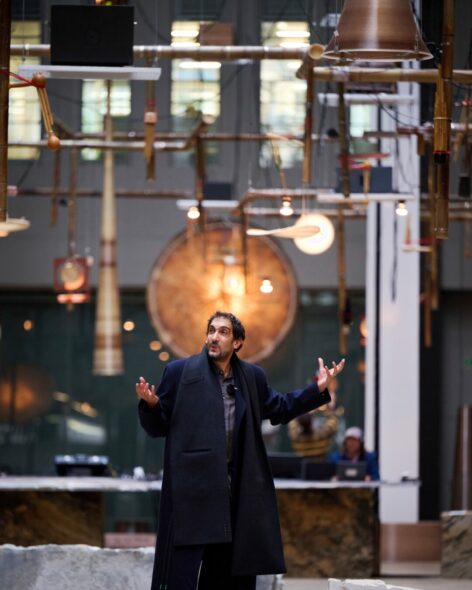
Tarek Atoui is an artist and electroacoustic composer whose practice explores how sound shapes perception. Working through installations, experimental acoustic environments and collaborative performances, he develops sculptural instruments and systems that investigate how materials transmit and reflect sound.
Participation and social connection are central to his work, with audiences invited to encounter sound through interaction and multi-sensory environments. For the Hyundai Commission, this approach expands across Tate Modern’s Turbine Hall, transforming it into an evolving space for listening.
INSIDE THE TURBINE HALL


Installation views of Tarek Atoui’s Hyundai Commission at Tate Modern.
The Brief
Tarek’s Turbine Hall installation brings instruments and sculptural forms into a spatial composition. Our design work focused on how printed shapes, their scale and their connections could support this sound-led environment while responding to the hall’s height and the surrounding bamboo structure.
We developed the parts as coordinated families, balancing visual character with practical requirements such as structural support, assembly, access and the relationship between each printed form and the objects around it.
Forms for the Soundscape
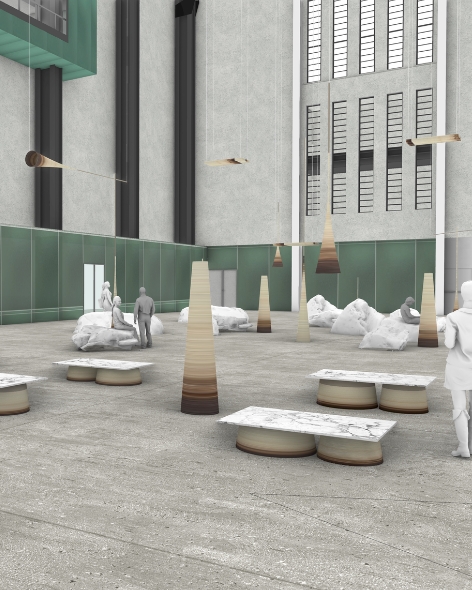
Horns. Nine horns, reaching up to 8 metres, hang from the roof structure in three families of three lengths. Each family has a distinct bell size, creating one visual language at different scales. The longest horns were printed as sections on a large-scale robotic arm, with each section slotting onto the one below.
Platforms. Thirty-six printed platforms in three sizes float alongside Tarek’s bamboo structure. We tested internal lattices to balance weight, stiffness and the way light passes through each panel.
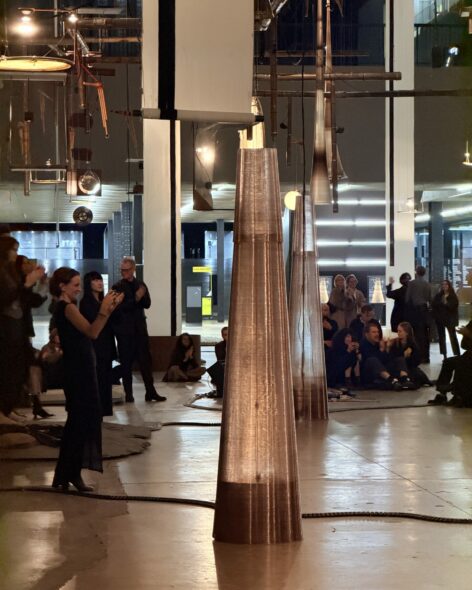
Towers. Six tall conical towers house instruments, cables and equipment. Each is printed in two parts: an inner base and an outer shell, with an access panel that allows the team to reach the equipment without taking the form apart.
Table bases. Sixteen printed conical bases in varied heights and diameters support the marble tabletops, carrying the installation’s material language down to the floor.
Boundary rings. Two low printed rings sit beneath the hanging fabric, keeping visitors at a comfortable distance.


Material Research
The project began with materials. In our own workshop, we compounded natural powders into PLA bioplastic and PETG, mixing, extruding, shredding and sieving each blend before printing it. We tested bamboo in a range of ratios and particle sizes, alongside limestone and basalt blends, comparing how each printed, how it held its shape at scale and how it looked under light.
Limestone gave a pale, mineral finish; basalt was hard to keep consistent in colour and flow. Bamboo gave the warm, brown, fibrous surface that suited Tarek’s bamboo structure best. The final installation uses that bamboo compound in two forms: with PLA bioplastic for the horns and rings, and with PETG for the platforms and towers.


How it was made
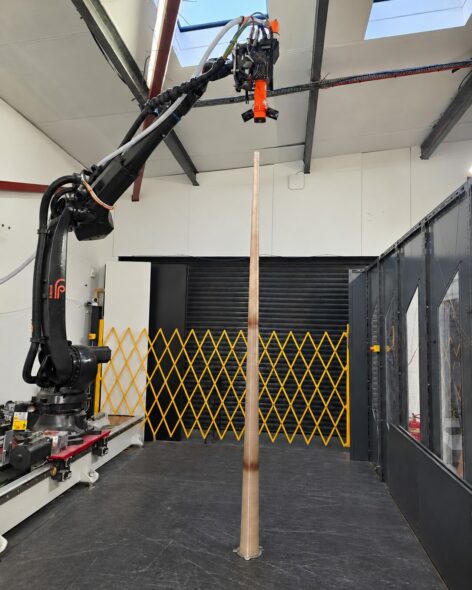
Every form was designed around the machine that would make it. The longest horn sections and the towers were printed on a large-scale robotic arm. The platforms came out of our mobile factory, a smaller robotic arm housed in a shipping container, and the remaining parts were printed on large-format 3D printers.
Full-scale prototypes shaped each form during development, and suspension and load tests carried out with Webb Yates Engineers verified the fixings before installation.
Project Facts
The installation brings together five families of 3D-printed forms, each developed to respond to its sound, structure and scale within the Turbine Hall.
Press & Publications
Read reviews, interviews and features on Tarek Atoui’s Hyundai Commission and its transformation of Tate Modern’s Turbine Hall into a space for listening.
The Guardian – Tarek Atoui’s Turbine Hall review – hallelujah, it’s raining musical instruments!
The Art Newspaper – ‘I see the Turbine Hall as a sound vessel’: artist Tarek Atoui on his Tate Modern commission
Artlyst – Tarek Atoui Takes Over Tate Modern’s Turbine Hall Commission Built On Listening
FAD Magazine – Tarek Atoui turns Tate Modern’s Turbine Hall into a living orchestra
designboom – tarek atoui turns tate modern’s turbine hall into a giant experimental orchestra
The Times – Has Tate Modern’s Turbine Hall had its day?
Art Dependence Magazine – Tarek Atoui Transforms Tate Modern’s Turbine Hall Into a Giant Experimental Orchestra
Financial Times – Tarek Atoui wants Turbine Hall visitors to hear his art — and feel the sound
The Telegraph – At last, an artwork grand enough to fill Tate’s Turbine Hall
AOL – Tate sounds eerie, Frieze returns and Cindy Sherman takes surreal selfies – the week in art
TEAM
Artist
Tarek Atoui, with Studio Tarek Atoui
Commission
Hyundai Commission: Tarek Atoui is in partnership with Hyundai Motor.
Mamou-Mani Architects – Architecture Studio Partner
Arthur Mamou-Mani, Fun Yuen, Samuel Calkins
Material contribution
With thanks to ADEZZ for supplying waste-stream bamboo powder used in the development of the 3D-printed elements.
Digital fabrication
Fab.Pub
Arthur Mamou-Mani, James Cheung, Fun Yuen, Clinton Glen Mendonca, Giovanni Panico, Antoine Proust, Vijayalakshmi Vijayappan, Harry Kingham, Minran Xue, Paris Lau, Baskar Subramanian and Faheem Kathawala
Structural engineering
Webb Yates Engineers
Photography
© Tate (Yili Liu, Ben Fisher)